Posted by Frankly Francis on October 27, 2012 under Books/Authors, Quotes | 
The waitress brought me another drink. She wanted to light my hurricane lamp again. I wouldn’t let her. “Can you see anything in the dark, with your sunglasses on?” she asked me. “The big show is inside my head,” I said.

I want to stay as close to the edge as I can without going over. Out on the edge you see all kinds of things you can’t see from the center.
All of the true things I am about to tell you are shameless lies.
Be careful what you pretend to be because you are what you pretend to be.
I tell you, we are here on Earth to fart around, and don’t let anybody tell you different.
All these people talk so eloquently about getting back to good old-fashioned values. Well, as an old poop I can remember back to when we had those old-fashioned values, and I say let’s get back to the good old-fashioned First Amendment of the good old-fashioned Constitution of the United States — and to hell with the censors! Give me knowledge or give me death!

Wake up, you idiots! Whatever made you think that money was so valuable?
New knowledge is the most valuable commodity on earth. The more truth we have to work with, the richer we become.
Many people need desperately to receive this message: I feel and think much as you do, care about many of the things you care about, although most people do not care about them. You are not alone.
People don’t come to church for preachments, of course, but to daydream about God.
A purpose of human life, no matter who is controlling it, is to love whoever is around to be loved.
Enjoy the little things in life, for one day you’ll look back and realize they were big things.
And I urge you to please notice when you are happy, and exclaim or murmur or think at some point, ‘If this isn’t nice, I don’t know what is.
I will say, too, that lovemaking, if sincere, is one of the best ideas Satan put in the apple she gave to the serpent to give to Eve. The best idea in that apple, though, is making jazz.

Perhaps, when we remember wars, we should take off our clothes and paint ourselves blue and go on all fours all day long and grunt like pigs. That would surely be more appropriate than noble oratory and shows of flags and well-oiled guns.
People say there are no atheists in foxholes. A lot of people think this is a good argument against atheism. Personally, I think it’s a much better argument against foxholes.
True terror is to wake up one morning and discover that your high school class is running the country.
To be is to do – Socrates
To do is to be – Sartre
Do Be Do Be Do – Sinatra
I was a victim of a series of accidents, as are we all.
Unusual travel suggestions are dancing lessons from God.
If you can do no good, at least do no harm.
Make love when you can. It’s good for you.
Ting-a-ling mother fucker.
There is love enough in this world for everybody, if people will just look.
Until you die…it’s all life.

Thanks to TV and for the convenience of TV, you can only be one of two kinds of human beings, either a liberal or a conservative.
We are healthy only to the extent that our ideas are humane.
Life is no way to treat an animal.
The insane, on occasion, are not without their charms.
There is no reason why good cannot triumph as often as evil. The triumph of anything is a matter of organization. If there are such things as angels, I hope that they are organized along the lines of the Mafia.
No matter how corrupt, greedy, and heartless our government, our corporations, our media, and our religious & charitable institutions may become, the music will still be wonderful.
A saint is a person who behaves decently in a shockingly indecent society.
What you can become is the miracle you were born to be through the work that you do.
My soul knows my meat is doing bad things, and is embarrassed. But my meat just keeps right on doing bad, dumb things.

She hated people who thought too much. At that moment, she struck me as an appropriate representative for almost all mankind.
And on the subject of burning books: I want to congratulate librarians, not famous for their physical strength or their powerful political connections or their great wealth, who, all over this country, have staunchly resisted anti-democratic bullies who have tried to remove certain books from their shelves, and have refused to reveal to thought police the names of persons who have checked out those titles.
Be soft. Do not let the world make you hard. Do not let pain make you hate. Do not let the bitterness steal your sweetness. Take pride that even though the rest of the world may disagree, you still believe it to be a beautiful place.

The Fourteenth Book is entitled, “What can a Thoughtful Man Hope for Mankind on Earth, Given the Experience of the Past Million Years. It doesn’t take long to read The Fourteenth Book. It consists of one word and a period. This is it: “Nothing.”
A sane person to an insane society must appear insane.
And so it goes…
Posted by Frankly Francis on October 3, 2010 under Books/Authors, Personal |

Frankly Francis & Kurt Vonnegut
My connection to Kurt Vonnegut (November 11, 1922 – April 11, 2007) began most innocently.
My father and I were doing a classic road trip in a VW Microbus in the spring of 1972 when we happened upon a drive-in theater featuring the recently released movie Slaughterhouse Five. What a beautiful accident!
“I was a victim of a series of accidents, as are we all” – Sirens of Titan
From there, I commenced to read everything that Vonnegut wrote. He became an essential element in my life. I was (and still am) an avid reader, but I connected with his writing and thought process better than with any other author.
“This is my principal objection to life, I think: It is too easy, when alive, to make perfectly horrible mistakes” – Deadeye Dick
His curiosity, humor, sense of irony and tragedy, and even his joy affected me deeply. No other writer could make me laugh at life’s follies while at the same time crying over them.
“We are what we pretend to be, so we must be careful about what we pretend to be” – Mother Night
Curiously enough, I came close to Vonnegut without realizing it during 1974-76. The parents of the drummer of the band that I was in were post-hippie secular humanists that hung with a very interesting crowd. Vonnegut turned out to be an element of this group though I missed that completely.

"I am notoriously hooked on cigarettes. I keep hoping the things will kill me. A fire at one end and a fool at the other" - Kurt Vonnegut
The next Vonnegut miss was in March of 1988 when he premiered his humanist requiem in my town. I have chatted with a guy who conversed with Vonnegut in the bedroom at the post-premier house party while Vonnegut was looking for his coat…can you imagine that?
His impact upon American culture has not yet been fully realized.

The Essential Kurt Vonnegut
I still believe that peace and plenty and happiness can be worked out some way. I am a fool – Jailbird
Around the millennium I began thinking. If I could meet any one individual currently living on this planet, who would it be? Musicians are certainly my most admired group, but for me it is a one way relationship: what would I say to David Bowie…I really like your music? There are a lot of philosophers and statesmen that I would love to meet, but none presently living. Current Politicos didn’t merit consideration. I soon knew who it would be.
Somewhere later, in the ensuing years, my best friend and wife says, “You know, I am getting tired hearing about if you could meet any single individual on this planet that you would choose Kurt Vonnegut.” She went on to say that I should either meet with him or stop talking about it. I thanked her for understanding and arranged the meeting.
It was a lunch in Manhattan at a little French restaurant that he enjoyed, with a few other people.
It was September 13, 2005, the day that his last work, “A Man Without a Country” was released.
It doesn’t really matter, but he ordered the salmon. I have no memory of what I ordered.
The conversation was incredibly delightful. He read us a poem that he had just composed. After our lunch, Vonnegut went to appear on the taping of the Daily Show with John Stewart.
I took a picture of Kurt as he walked away down Lexington Avenue, but I missed the picture completely, photographed my own finger on the lens, and only got his feet. Kurt Vonnegut walking away down the street and all I got was his feet. And yet, in ways I am still feeling, that picture is perfect.

Vonnegut's feet right along the shadow line on Lexington Ave
I remember watching the show that evening – Stewart introduced Vonnegut, “as an adolescent, he made my life bearable.”
I could not possibly put it any better.
So it goes.
Frankly,
Francis
P.S. It was some years later that I connected the dots to another story involving Vonnegut that made me realize even more how close we are all:
https://franklyfrancis.com/?p=587#comments
P.P.S Here’s Vonnegut’s appearance on the Daily Show:
Posted by Frankly Francis on April 23, 2010 under Books/Authors, Social Issues/Politics |
I had a real good idea what this book would say – I figured it would be preachin’ to the choir. Mostly because of that, I really took my time getting around to reading it. Published in 1979, I let it languish in my library for almost 30 years. Well, as it turns out, it was indeed preachin’ to the choir. And this choir really enjoyed the preachin’ it got.

Not to exclude Rose Friedman, but…
Here’s my take: Milton Friedman valued our individuality. He felt that the collective acts of individuals pursuing their own interests would provide much more, in terms personal satisfaction and economic resources than the results of individuals acting in a collective. It follows then, his basic tenet that without economic freedom, there cannot be political freedom.
The fusion of economic and political freedom becomes the optimum result. Note, Friedman was much too realistic to advocate utopia – he certainly knew that there was no perfection in any approach, but held firmly to the value of recognizing each individual life as having a value that exceeded that of the state. Frankly Francis says: True That!
A few thoughts directly from Friedman:

Milton Friedman
“A society that puts equality before freedom will get neither. A society that puts freedom before equality will get a high degree of both”
“One of the great mistakes is to judge policies and programs by their intentions rather than their results”
“I think the government solution to a problem is usually as bad as the problem and very often makes the problem worse”
“I say thank God for government waste. If government is doing bad things, it’s only the waste that prevents the harm from being greater”
Amen Brother.
Here’s a quote about Friedman by George Schultz that I think is worth aspiring to – “Everyone loves to argue with Milton, particularly when he isn’t there.”
Milton was philosophically a libertarian. Politically, he was a Republican, but that, he explained was for expediency, perhaps much the same as Congressman Ron Paul.
During his lifetime he was recognized with the John Bates Clark Medal (1951), the Nobel Memorial Prize in Economics (1976), and in 1988, both the Presidential Medal of Freedom and the National Medal of Science. Big Stuff!
I must say that as reading Ayn Rand’s “Atlas Shrugged” strengthened my existing perceptions, reading Freidman solidified my existing beliefs.
It is distinctly your own unique and wonderful life – Do yourself a real favor and read this book.
Frankly,
Francis
Posted by Frankly Francis on March 6, 2010 under Books/Authors |
A fair time ago, The Last Lecture was recommended to me by someone whose opinion I respect.

For those that have let the memories slip away, Randy Pausch was a Professor at Carnegie Mellon who was diagnosed with terminal cancer at the age of 46. In 2007, he gave a “last lecture” that got all kinds of attention and subsequently expanded upon it in best-selling book form. He died in 2008.
Back to me: I sure took my sweet time getting around to reading it. I really didn’t want to read it. We all have our own unique make-up, quirks, and traits. For better or for worse, I operate under the idea that the masses are always wrong. So as everybody was reading The Last Lecture, then by my standards, it was not for me.
As Mark Twain said, “When you find yourself on the side of the majority, it is time to pause and reflect.”
But in all due fairness, the masses are not always wrong. And they certainly weren’t wrong in their embrace of Randy Pausch’s memoir.
I’d like to say that I enjoyed reading it, and to a degree I did, but my overall take on it was not too dissimilar from my post funeral home introspection…in that having paid my last respects to the deceased and my sympathy to the family, I realize that the vast majority of the things that I have to do and deal with that seem to really matter, really do not matter all that much. I do my best to not get caught up in petty details, but I would be misleading if I said that I don’t get caught up in the petty details.
Professor Pausch’s book goes a long way in pointing out what is important and what is not so important. He does not get deeply philosophical. He certainly does not say anything that has not been said before. His take is refreshingly simple and straight forward. I would like to think that it is naturally intuitive, but even if that is the case, it never hurts to have meaningful things pointed out.

Randy Pausch
Occam’s razor dictates that the simplest explanation is the best explanation.
In fact, Pausch’s quote “We cannot change the cards we are dealt, just how we play the hand” should make Occam proud. I think, for ourselves and more so for our own understanding of the people around us, we would be well advised to embrace this principle.
My summary: It is a short, easy read that offers valuable insights – well worth the time I spent on it.
In closing, my too late thanks to Randy Pausch for taking the time during your last days to express your thoughts. I wish you were amongst us longer.
Frankly,
Francis
Posted by Frankly Francis on January 23, 2010 under Books/Authors |
I really enjoy reading Michener. And fortunately for me, he wrote a lot of books. I have historically travelled through time to Alaska, Spain, Poland, Texas, Hawaii, Africa, The Caribbean, Chesapeake Bay, Colorado, Mexico, and so forth.

Not too long ago I stumbled upon “Caravans” – a book centered in Afghanistan, written in the early 1960’s. Funny how the more things change, the more they stay the same. Michener could have published it today with minimal updating if he were still alive. And the foregoing is more than a subtle hint to remember the lessons of history. But I digress…

Anyways, that led me into the abyss of my library to look for other Michener gems yet to be read. Low and behold, “The Source” was still waiting for me. Published in 1965, the story alternates between the histories of the initial inhabitants of the land that is now Israel to the modern dynamics of building a state in a hostile place.
Jewish history is primarily delved into, but the Arabs, Romans, Greeks and Europeans get their share of attention. Along with Baal, the Greek and Roman Gods are profiled, but the main focus in this regard is upon the Creator that the Jews do not refer to by name.
Let me say that I am pleased that I was not placed in direct lineage of God’s Chosen People. I do not think I am worthy. And even if I am, I much prefer not to have that target placed upon me by the other dwellers of planet Earth. I’ve got enough problems.
For the record, I do feel a very deep affinity with and respect for the Jewish People.
As usual when reading Michener, I found it interesting and enjoyably educational. He does have a tendency to write at length, but when you have a big topic, what choice do you have? There are other authors on my “must read” list, but I am looking forward to perhaps finding other books by Michener that I have not had the pleasure of reading yet.
Oh, I should mention that it was Michener who sparked my determined interest in running the bulls – something that I look forward to doing before this is all over, whatever this is.
Frankly,
Francis
Posted by Frankly Francis on October 15, 2009 under Books/Authors |
I have recently finished reading, over the course of this year, Neal Stephenson’s Baroque Cycle. It comprises three volumes entitled “Quicksilver,” “The Confusion.” and “The System of the World.”

It was not a light weight exercise, as the three books amount to almost 3,000 pages. Stephenson can make Michener look like a short story writer. However, if the writing is good, length or brevity is of no concern to me. For the record, I, personally, think the writing is excellent.

I have found that the smarter I get, the more I realize how much I don’t know. Stephenson makes me feel like a complete idiot.
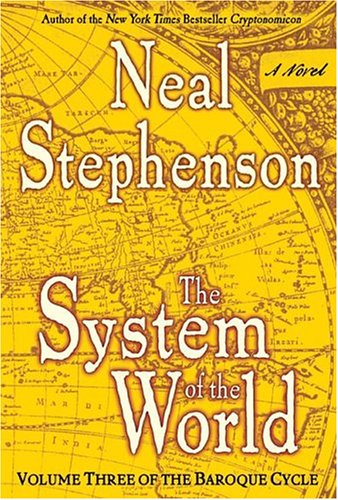
Many, many years ago, my good friend Fast Eddy handed me a copy of “Snow Crash” and told me that it was mandatory reading. It was one of Stephenson’s earliest published works (1992). It detailed an Internet that I would like to experience before I take the Big Sleep. It was intriguing and I’ve been reading his books ever since.

Neal Stephenson
The Baroque Cycle, covering the second half of the 17th and early 18th centuries, covers a lot of concepts, history, and geography. As I mentioned, it can get fairly deep, but it is still very entertaining. So many thanks to the author for doing an incredible amount of research, and then spending the time and effort to write this series of books.
By the way, Eddy tells me that Stephenson’s latest published work, “Anathem” is his best yet. Can’t wait to get to it!
Frankly,
Francis


